
What Are SEO, AEO, and GEO, and Why Do They Matter for Your Business?
Lori Osborne • October 15, 2026
black SEO text on yellow background with a magnifying glass as the O


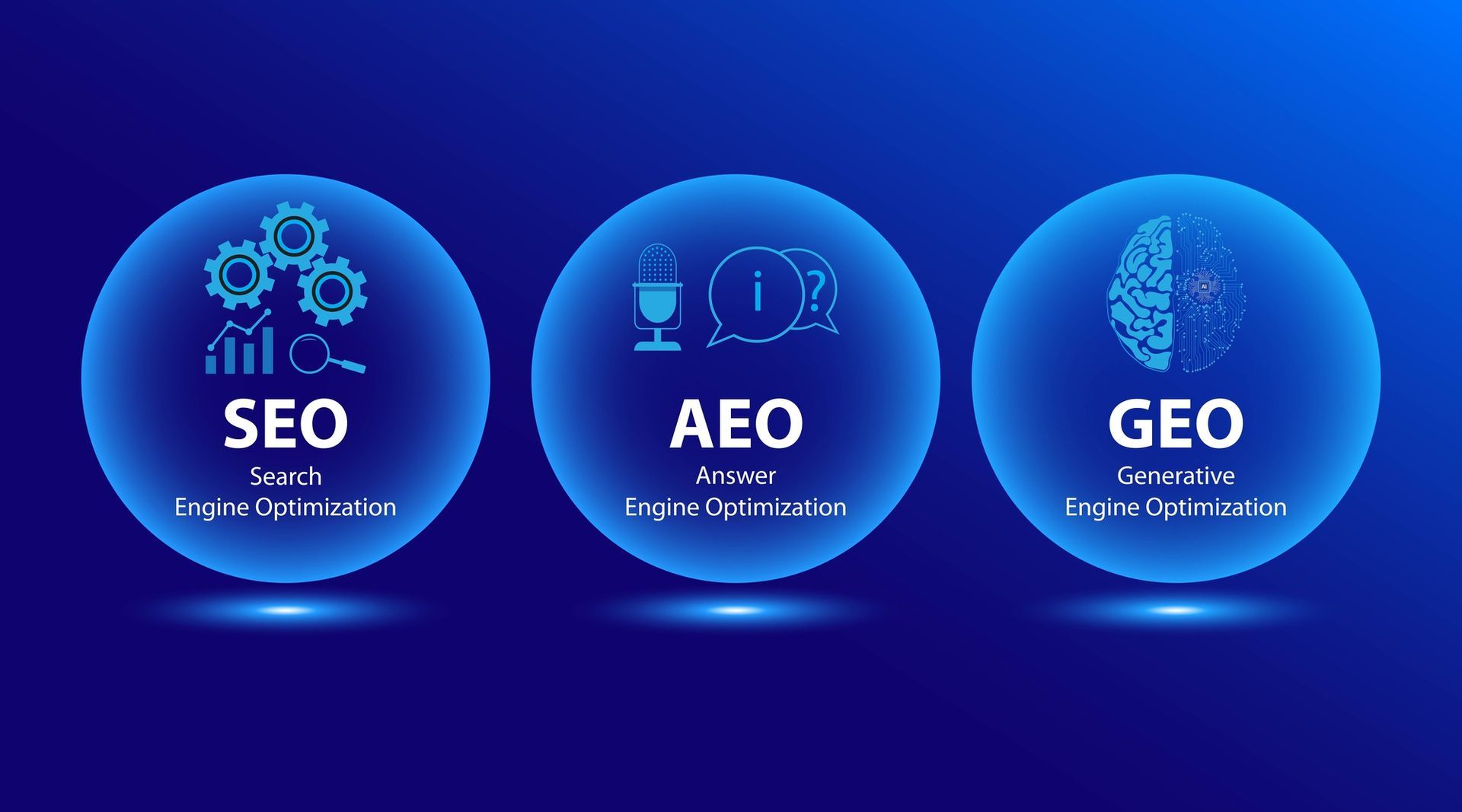
SEO, AEO, and GEO are overlapping approaches to helping people find, understand, and evaluate your business online. SEO supports visibility in traditional search results. AEO helps your content answer questions clearly. GEO focuses on how generative AI systems discover, interpret, and represent your business. Together, they support a stronger search and AI visibility strategy—but none guarantees rankings, citations, or recommendations.


What is SEO?

Search engine optimization (SEO) helps search engines discover, understand, and evaluate your website for relevant searches. It includes useful service pages, accurate business information, clear site structure, accessible content, technical performance, and links or mentions that help establish context and credibility.


For a local business, SEO also involves maintaining accurate business profiles, relevant location information, and consistent contact details. The goal is not simply more visitors—it is helping the right people find reliable information when they need it.


What is AEO?

Answer engine optimization (AEO) organizes content so that a person—or a search experience that generates a direct answer—can quickly find a useful response to a specific question.


Answer-first writing is a practical starting point: state the answer near the beginning, explain it in plain language, and provide details that support it. Descriptive headings, focused FAQs, and clearly identified expertise can make pages more useful. FAQs should answer real customer questions rather than repeat keywords.


What is GEO?

Generative engine optimization (GEO) focuses on improving how generative AI systems discover, interpret, reference, and describe a business or its expertise.


GEO is not a switch you turn on. AI systems vary in what sources they retrieve and cite, and their answers change over time. Useful original content, consistent information across trustworthy sources, clear attribution, and relevant third-party mentions can help establish the evidence those systems may encounter.


How do SEO, AEO, and GEO work together?

SEO helps relevant pages become discoverable; AEO makes their answers clearer; and GEO considers how the business and its information are represented in AI-generated responses. These practices share many fundamentals and should not be managed as three disconnected campaigns.

For example, a retirement professional might publish a clear, compliant explanation of a retirement-income question (AEO), make that page accessible and easy to discover (SEO), and reinforce the firm’s identity and expertise through consistent profiles and credible external references (GEO).


Why does search and AI visibility matter for financial services professionals?

Prospective clients often research a financial professional before scheduling a conversation—even when the introduction came from a trusted referral. They may compare websites, search for credentials, read reviews, and ask AI tools questions about services or local options.

A professional website should make it easy to verify who you are, whom you serve, what services you provide, and how to take the next step. In regulated industries, accuracy, appropriate disclosures, and compliance review matter more than chasing visibility with exaggerated claims.


What should a business do first?

Begin with the questions your ideal clients actually ask and make sure your website answers them clearly. Then strengthen the information that helps people—and digital systems—understand your business.


A practical starting checklist:

  • Clarify your positioning, services, ideal clients, and geographic areas served.
  • Publish useful, answer-first service and educational pages with accurate, current information.
  • Keep business names, contact details, and profiles consistent across important platforms.
  • Make authorship, qualifications, and relevant supporting evidence easy to verify.
  • Use appropriate structured data to describe page content accurately; do not rely on schema alone for visibility.
  • Review reviews and other reputation signals, responding professionally where appropriate.


How can you measure progress?

Track qualified inquiries, relevant organic search traffic, search visibility for important topics, Google Business Profile activity, and engagement with service pages. For AI visibility, periodically test a consistent set of relevant questions and record whether your business is mentioned or cited, how accurately it is described, and which sources are referenced. AI answers vary by platform, prompt, location, and time, so treat these checks as directional evidence—not a definitive ranking.


A stronger online presence starts with credibility

Search is changing, but the fundamentals of earning confidence have not. People still want to know whether a business understands their needs, communicates clearly, and can back up what it says. SEO, AEO, and GEO are most valuable when they reinforce those fundamentals instead of distracting from them.


That is why BizBolster approaches search and AI visibility as part of a connected credibility system: thoughtful brand positioning, clear messaging, a well-built website, useful educational content, a consistent local presence, and reputation signals that support the story your business tells. The objective is not to chase every new acronym. It is to make your business easier to discover—and easier to trust once it is found.

  • Is GEO replacing SEO or AEO?

    No. GEO overlaps with SEO and AEO rather than replacing them. Traditional search visibility and clear, useful answers remain important, while GEO adds attention to how generative AI systems find and represent information.

  • Does adding FAQs guarantee that my business will appear in AI answers?

    No. Helpful FAQs can make information easier to understand and use, but neither FAQs nor FAQ schema guarantee that an AI system will cite, mention, or recommend a business.

  • How long does it take to see results from SEO, AEO, and GEO?

    There is no fixed timeline. Technical fixes can be discovered relatively quickly, while lasting visibility and credibility usually develop over time. AI-generated answers can also change from one query or platform to another.

Build visibility on a foundation of credibility

Wondering whether your website and online presence clearly communicate why clients should choose you? Explore The Credibility Platform™ and Local Credibility Positioning™ at bizbolster.com to see how BizBolster brings brand strategy, website development, local visibility, and reputation together.
BizBolster Blog: 4 Reasons Brand Consistency is very important for Business
By Lori Osborne • June 3, 2026
Learn more about how incorporating brand consistency across all your digital marketing platforms can help improve your business overall.
Cybersecurity slide with code, red keyboard glow, and text: “The Hidden Risk No one is Talking About”
By Lori Osborne • February 20, 2026
Over the past month, I’ve been navigating something I never expected to deal with. Phishers have been impersonating me. They created fake accounts. They reached out to my clients. They tried to look like me - using my name and reputation to exploit the trust I’ve spent years building. It was unsettling. Not because I don’t understand that scammers exist. But because it was a stark reminder of something every Thought Leader needs to understand: Visibility without protection is vulnerability. And in today’s digital world, authority is an asset worth protecting. The Reality of Modern Visibility As business owners, coaches, consultants, and speakers, we are constantly told to: Be visible. Show up consistently. Put yourself out there. Build your brand. And yes - visibility matters. But here’s what doesn’t get talked about enough: The more visible you become, the more attractive you are to bad actors. Hackers, phishers, impersonators, and spammers are getting smarter. They don’t need access to your systems to cause damage. They only need access to your public presence. Your name. Your photo. Your brand. Your email. Your clients. And once someone is pretending to be you, your authority is on the line. Your reputation is your digital currency. How This Impacts Your Authority Authority isn’t just about expertise. It’s about trust. When someone receives a suspicious message that appears to come from you, even if they later realize it’s fake, something subtle happens: Doubt enters the equation. And doubt erodes authority. You can spend years building credibility, and one impersonation attempt can create confusion in seconds. That’s why protecting your brand is no longer optional. It’s leadership. The Lesson This Reinforced for Me One of the biggest takeaways from this experience was how easily publicly listed email addresses - anywhere online - can be scraped, spoofed, and misused. Bots scrape websites and social media constantly. If an email address is publicly visible, it can be harvested. Once harvested, it can be used in spoofing attempts or impersonation schemes. Please know - this isn’t fear-based marketing. It’s reality. And while we cannot eliminate risk entirely, we can dramatically reduce exposure. What I Strongly Recommend If your goal is to build authority online, I encourage you to rethink how accessible your email address is. Instead of posting your email address directly on: Your website Your speaker page Your social media profiles Your client galleries Public PDFs or downloads Consider: Using secure contact forms on your website Encouraging direct messages on social platforms Creating structured inquiry forms for speaking or consulting Limiting publicly displayed email addresses wherever possible Contact forms create a protective layer. They reduce automated scraping. They give you more control. They create intentional boundaries. And boundaries build trust. How to Spot an Impersonation Attempt Here’s what made these emails convincing: Gmail addresses that looked almost legitimate My real credentials listed in the signature References to topics I regularly discuss — hosting, compliance, SEO Familiar tone But here’s what gave them away: Generic greetings like “Hi Dear” Slightly broken English Subtle inconsistencies in phrasing A Gmail account instead of my official domain These attacks are sophisticated enough to feel plausible, but sloppy enough to reveal themselves if you slow down. And that’s the key. Slow down. If you receive an email that feels even slightly off: Do not reply within that thread. Instead: Contact the person at their known email address Call their verified phone number Reach out through LinkedIn or another established channel Never verify through the suspicious email itself and never forward or reply to that email! This is one of the most common impersonation tactics targeting business owners and Thought Leaders right now. The Bigger Leadership Lesson Modern authority requires discernment. It requires boundaries.  And it requires teaching your audience how to protect themselves as well. The goal isn’t fear. The goal is awareness. Because awareness protects trust. And trust is everything. Authority Requires Boundaries We often think authority is about: Confidence. Expertise. Visibility. Positioning. But mature authority includes protection. It includes systems. It includes security. It includes intentional design. Your online presence should not just attract clients. It should protect your reputation. Because here’s the truth: If someone can easily impersonate you, your digital foundation needs strengthening. And that’s not about paranoia. It’s about professionalism. This Is Bigger Than Email This experience wasn’t just about phishing. It was a reminder of something I talk about often: Most Thought Leaders focus on looking credible online. Very few focus on being structurally secure. There’s a difference. A polished website is not the same as a protected authority platform. A beautiful LinkedIn profile is not the same as a safeguarded digital presence. Authority is not just branding. It’s infrastructure. And infrastructure must be built intentionally. The New Standard for Thought Leaders If you are building a brand that positions you as the go-to expert in your space, ask yourself: Is my online presence just visible — or is it protected? Is my contact information structured strategically? Have I created boundaries between public visibility and direct access? Have I thought about how someone could misuse my brand assets? These are not dramatic questions. They are responsible ones. Because the more impact you create, the more valuable your name becomes. And valuable assets deserve protection. Final Thoughts Over the past month, I’ve been reminded that authority is something you build - and something you guard. We cannot control the existence of scammers. But we can control how exposed we make our digital front door. Stay visible. But stay strategic. Because in today’s landscape, protecting your brand isn’t just smart. It’s part of being a modern Thought Leader.
Picture with blue background and the blog title and a mobile phone with a Facebook like icon above i
By Lori Osborne • December 12, 2025
Discover the major changes coming to Facebook in 2026. Learn what these shifts mean for your content strategy and how to stay visible, relevant, and client-attracting.