What Are SEO, AEO, and GEO, and Why Do They Matter for Your Business?
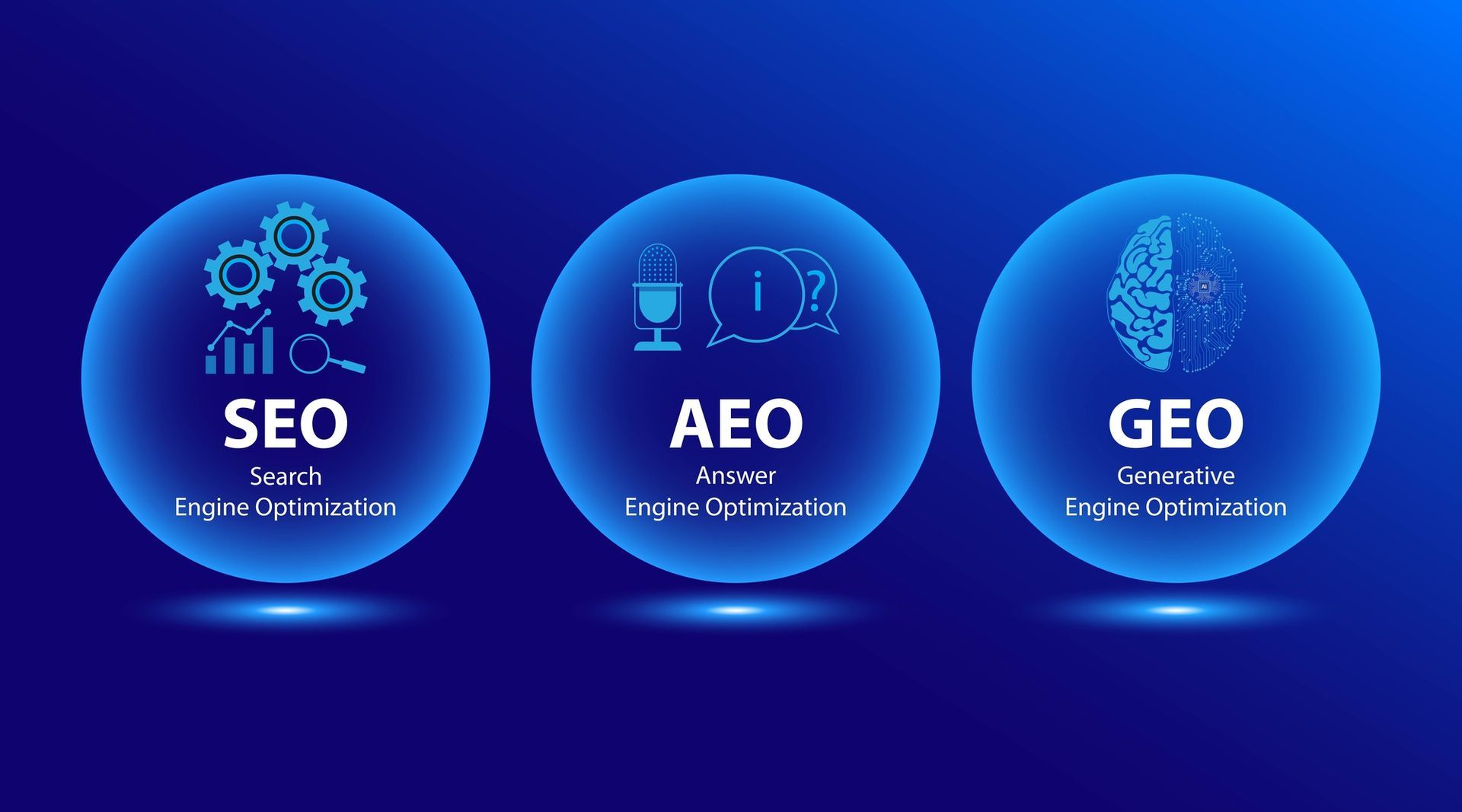
SEO, AEO, and GEO are overlapping approaches to helping people find, understand, and evaluate your business online. SEO supports visibility in traditional search results. AEO helps your content answer questions clearly. GEO focuses on how generative AI systems discover, interpret, and represent your business. Together, they support a stronger search and AI visibility strategy—but none guarantees rankings, citations, or recommendations.
What is SEO?
Search engine optimization (SEO) helps search engines discover, understand, and evaluate your website for relevant searches. It includes useful service pages, accurate business information, clear site structure, accessible content, technical performance, and links or mentions that help establish context and credibility.
For a local business, SEO also involves maintaining accurate business profiles, relevant location information, and consistent contact details. The goal is not simply more visitors—it is helping the right people find reliable information when they need it.
What is AEO?
Answer engine optimization (AEO) organizes content so that a person—or a search experience that generates a direct answer—can quickly find a useful response to a specific question.
Answer-first writing is a practical starting point: state the answer near the beginning, explain it in plain language, and provide details that support it. Descriptive headings, focused FAQs, and clearly identified expertise can make pages more useful. FAQs should answer real customer questions rather than repeat keywords.
What is GEO?
Generative engine optimization (GEO) focuses on improving how generative AI systems discover, interpret, reference, and describe a business or its expertise.
GEO is not a switch you turn on. AI systems vary in what sources they retrieve and cite, and their answers change over time. Useful original content, consistent information across trustworthy sources, clear attribution, and relevant third-party mentions can help establish the evidence those systems may encounter.
How do SEO, AEO, and GEO work together?
SEO helps relevant pages become discoverable; AEO makes their answers clearer; and GEO considers how the business and its information are represented in AI-generated responses. These practices share many fundamentals and should not be managed as three disconnected campaigns.
For example, a retirement professional might publish a clear, compliant explanation of a retirement-income question (AEO), make that page accessible and easy to discover (SEO), and reinforce the firm’s identity and expertise through consistent profiles and credible external references (GEO).
Why does search and AI visibility matter for financial services professionals?
Prospective clients often research a financial professional before scheduling a conversation—even when the introduction came from a trusted referral. They may compare websites, search for credentials, read reviews, and ask AI tools questions about services or local options.
A professional website should make it easy to verify who you are, whom you serve, what services you provide, and how to take the next step. In regulated industries, accuracy, appropriate disclosures, and compliance review matter more than chasing visibility with exaggerated claims.
What should a business do first?
Begin with the questions your ideal clients actually ask and make sure your website answers them clearly. Then strengthen the information that helps people—and digital systems—understand your business.
A practical starting checklist:
- Clarify your positioning, services, ideal clients, and geographic areas served.
- Publish useful, answer-first service and educational pages with accurate, current information.
- Keep business names, contact details, and profiles consistent across important platforms.
- Make authorship, qualifications, and relevant supporting evidence easy to verify.
- Use appropriate structured data to describe page content accurately; do not rely on schema alone for visibility.
- Review reviews and other reputation signals, responding professionally where appropriate.
How can you measure progress?
Track qualified inquiries, relevant organic search traffic, search visibility for important topics, Google Business Profile activity, and engagement with service pages. For AI visibility, periodically test a consistent set of relevant questions and record whether your business is mentioned or cited, how accurately it is described, and which sources are referenced. AI answers vary by platform, prompt, location, and time, so treat these checks as directional evidence—not a definitive ranking.
A stronger online presence starts with credibility
Search is changing, but the fundamentals of earning confidence have not. People still want to know whether a business understands their needs, communicates clearly, and can back up what it says. SEO, AEO, and GEO are most valuable when they reinforce those fundamentals instead of distracting from them.
That is why BizBolster approaches search and AI visibility as part of a connected credibility system: thoughtful brand positioning, clear messaging, a well-built website, useful educational content, a consistent local presence, and reputation signals that support the story your business tells. The objective is not to chase every new acronym. It is to make your business easier to discover—and easier to trust once it is found.
Is GEO replacing SEO or AEO?
No. GEO overlaps with SEO and AEO rather than replacing them. Traditional search visibility and clear, useful answers remain important, while GEO adds attention to how generative AI systems find and represent information.
Does adding FAQs guarantee that my business will appear in AI answers?
No. Helpful FAQs can make information easier to understand and use, but neither FAQs nor FAQ schema guarantee that an AI system will cite, mention, or recommend a business.
How long does it take to see results from SEO, AEO, and GEO?
There is no fixed timeline. Technical fixes can be discovered relatively quickly, while lasting visibility and credibility usually develop over time. AI-generated answers can also change from one query or platform to another.
Build visibility on a foundation of credibility
Wondering whether your website and online presence clearly communicate why clients should choose you? Explore The Credibility Platform™ and Local Credibility Positioning™ at bizbolster.com to see how BizBolster brings brand strategy, website development, local visibility, and reputation together.